
Learning How to Drive in Spain (Part 1 – The Basics)
Please Note: This post contains affiliate links to products, which means that we may receive a commission for purchases. For more information, see our disclosures here. Thanks for your support!

Dear Gabi,
The time has finally come. After 12+ years living in Spain–priding myself on walking everywhere I could, considering myself a public transportation connoisseur, and admittedly being a bit of a passenger princess–I have finally decided to suck it up and get my Spanish driver’s license.
The decision is not one that I came to easily because the process is not very straightforward. Much to my frustration, there is no recognition of U.S. driver’s licenses in Spain so, despite my nearly 20 years(!!) of driving experience, I have needed to start over from zero.
I am still only in the first stage of obtaining my license (studying for, but yet to take, my theoretical exam), but I’ve noticed that there are very few first-hand accounts of this process in Spain, at least from a foreigner’s POV. Thus, I thought I would do my best to detail the full experience.
As such, this post will only cover the basics of the slightly different routes you can take when learning to drive in Spain. I hope that my insights thus far will help you too embark on the process of getting your driver’s license in Spain.
1.) You must go through an autoescuela
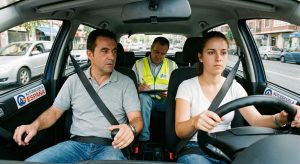 The official theoretical and practical driving exams in Spain are run by the DGT (Dirección General de Tráfico). This is Spain’s national agency in charge of licenses, exams, road-safety policy, and enforcement systems. Despite driving schools not being the ones that can directly license you, it is still crucial for you to have a driving school (autoescuela) represent you when you sign up for and attend these exams. I say “crucial” rather than necessary because you CAN manage to sign yourself up for and take the theoretical exam on your own. However, I would argue that it doesn’t make sense to do so.
When you get to the point of taking your practical (behind-the-wheel) exam at the DGT, you’ll find that it’s necessary to be in a dual-control vehicle, accompanied by a licensed instructor sitting at those controls (the examiner will sit in the back). Thus, although it’s plausible to handle the theoretical exam on your own, you’re going to need an autoescuela eventually. So, why not streamline the process for yourself and also get your study materials, practice exams, and assistance with exam registration through that school?
Typically, autoescuelas have a package deal (often marketed as the promoción) that includes (1) in-person and/or online classes, (2) study resources, (3) practice exams, (4) a certain number of practical driving lessons, and (5) assistance with the DGT process. Through this set-up, the driving school will completely handle the booking of your exams with the DGT when you are ready. That’s a big bureaucratic win for me!
Note: This standard set-up does mean that you are a bit more beholden to your autoescuela and you may feel frustrated if you need to argue with them over taking more lessons or booking an exam. But a good driving school should have your best interests in mind and focus on getting you the right amount of lessons first to ensure you can pass your official exams on the first try. (There is truth to the horror stories about needing to test and retest, requiring many more prácticas than you may have hoped but that outcome is not inevitable. I truly believe that diligent study and solid practice on your behalf can go a long way. Get a feel for what past students have felt by reading some reviews before signing up anywhere.)
2.) You must pass your theoretical exam before starting practical lessons
 In concept, this makes complete sense. Autoescuelas want students to understand the rules of the road and how to drive [in theory] before actually jumping behind the wheel. In reality, unfortunately, this can mean multiple months between passing your téorica exam and even starting your practical lessons.
I spoke to multiple autoescuelas and the rules at all of them were the same. You could not be put on the waiting list for prácticas until you have your (passing) teoría exam results in hand. I understand the thought process, but am still disappointed. Given the long delays, they wouldn’t really have students still learning the theory material taking behind-the-wheel lessons simultaneously, so I wish things could be more flexible.
While you don’t want under-prepared students behind the wheel, I would argue that you DO want students with their studies still fresh in their mind. An inevitable, multi-month wait period between theory and practice is not good either. But that’s simply what’s happening, at least in 2026. Supposedly, this is because the DGT is backed up and has very few exams slots so autoescuelas are metering their pace as well.
In my case, this means I will likely have three months to wait between passing my theory exam and starting my practical lessons. It’s a bit discouraging, but there’s nothing I can do about it.
3.) You can opt to take your lessons and/or the exam in English, but it may not be the best idea
The DGT officially offers the theoretical exam in English so if you have no understanding of Spanish, this is the route to take. On the other hand, if you have a decent level of Spanish, I would highly recommend studying and taking the exam in Spanish.
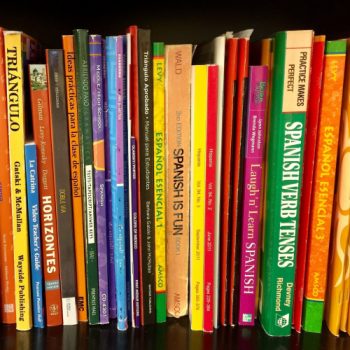
Despite many autoescuelas offering materials, lessons, and practice exams in English, you will often find that these resources have simply been translated word-for-word and do not make much sense. My online textbook can be toggled between Spanish, English, French, and German so, occasionally, I will check my understanding of a single word in English. This option is sometimes useful for me but, if I don’t understand a full sentence, I will get a translation elsewhere as the quality of the in-house English version is very low.
At the end of the day, it really comes down to choosing whatever feels more manageable for you. For me, it’s more work to read these materials in English and constantly need to decipher the meaning than it is to read in Spanish and check my understanding only when needed. Of course, I opted for a local autoescuela that did not promote their English-language offering, so this is not surprising.
 If you do choose to study with a driving school that is better equipped to handle English-language students, you will hopefully find better quality translations and teachers who actually speak the language. However, if you’re from the USA, be aware that materials will likely use British English and so, even when expressed correctly, the phrasing and terminology may still feel foreign to you (think “give way” rather than “yield,” “bonnet” instead of “hood,” “dual carriageway” vs. “divided highway,” etc).
Pro-Tip: Just because you may opt to take your teoría lessons and exam in Spanish doesn’t mean you are not allowed to use outside English-language resources. In fact, I have decided to think a bit outside the box and put to use this Driving in Spain crash course. It’s an online resource you can obtain through Tripiamo that is generally geared to travelers who will be renting a car abroad. However, I think it will be quite useful for my purposes as well. I haven’t taken any of the video classes yet, but the on-the-go PDF is an excellent “cheat sheet” of important road signs and rules that may be specifically surprising to me as a foreigner.
4.) You can opt to take your lessons in a manual or automatic car
 As you may know, outside of the US, automatic cars are not the norm and so if, like me, you learned to drive previously in automatic cars, you will immediately be met with an important choice: learn the new skill of driving manual or stick to automatic.
In theory, both options exist for you but you should definitely think through which you would prefer BEFORE selecting your autoescuela because the availability of automatic cars for prácticas is not a given. In fact, it seems to be less common than I first assumed.
Personally, I always envisioned learning to drive manual because passing the exam in an automatic car in Spain means that your license will always carry this ‘restriction’. I really wanted to meet the challenge and do things the Spanish way. However, I didn’t anticipate the season of my life in which I would be taking on this task. As a toddler mom, simply taking my lessons, studying from materials, and needing to pass the exam in Spanish uses up a lot of my mental capacity. The thought of truly having to learn a new skill on top of that was adding unnecessary pressure.
I’m really grateful that the local autoescuela I chose back in 2024 has an automatic car available. When we moved house just a month after I signed up for classes, I slowly stopped studying and imagined that I would pick up the process this year with a different autoescuela closer to me. However, I quickly found that my original driving school is one of the closest ones that has an automatic car, even though it’s a 20 minute car ride away!
It’s not my ideal scenario, but given all the online study materials and the next point, it is doable.
5.) It is common practice for your driving teacher to pick you up for lessons
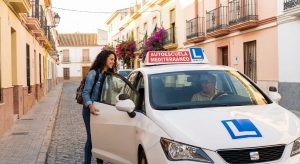 Contrary to my assumptions based on experience in the USA, it is actually completely normal for your teacher (or a fellow student finishing their lesson) to pick you up for your prácticas. Thus, choosing an autoescuela that is not within walking distance of your home is not the end of the world.
In addition to meeting directly at the school, they will likely suggest a few common pick-up locations and/or sometimes even meet you right at your house. Depending on how far away the pick-up location is from the school, this may come at an added fee but it’s definitely something to inquire about if you would plan to pay for public transportation or require coordinating a ride to attend your prácticas anyway.
(This point is more related to your experience later on with learning to drive, but I include it here so that you understand this practice is normal and don’t feel limited to only the autoescuelas nearest your home.)
6.) There is (generally) a time limit linked to your autoescuela enrollment
 Something to keep in mind is that driving schools often have a timeframe attached to their packages. The length and flexibility of this period will vary by school, but it is important to be aware of so that you can plan out your studies accordingly.
I originally misinterpreted the timeline because other students often asked to reactivate their access to the aula virtual (virtual classroom) without issue. However, there are two different things at play (at least in the case of my autoescuela): (1) access to the online materials and (2) the deadline to pass your exam. It turns out that my driving school automatically activates your online account for 100 days. This is flexible and can be reactivated at no cost. However, only the first year is included in the flat rate (and I’ve heard other schools only include six months). If you need more time than that to pass your theory exam, there is an added fee.
This felt perfectly reasonable to me, especially given my personal case of how much time had passed and my readiness to enroll at an entirely different school. However, it might be important for you to inquire about and keep in mind if you plan to take your time studying.
Note: On the topic of enrollment, be aware that it is common practice for autoescuelas to charge an enrollment fee, called matrícula. My experience is that this fee is included in the promoción set price, but that is not always the case. If you are shopping around, be sure to inquire ahead of time so you can compare prices accurately.
 As you can see, this article by no means covers the full experience of learning how to drive in Spain. Rather, these are the basics to consider so that you can go into the autoescuela search feeling informed and ready to find a school that will best fit your needs.
So far, I am still at the start of my own process of procuring my driver’s license in Spain, but I’ll take you along for the ride by sharing further articles about how to prepare for your theory exam, take your practical lessons, and pass the DGT driving exam as I gather the first-hand know-how myself. I hope it proves useful to you.
Let me know in the comments if you have any questions I could answer here (or be sure to cover in future related topics). Happy driving!
Sincerely,
Spain
Some images in this post were created with AI for illustrative purposes.



4 Comments
Tina
Thank you so much for this.
I have visited Spain many times and thought that I would never be able to drive there. It never occurred to me to take a specific training course to lessen the stress!
I am actually considering taking my own car there by ferry this summer, so the Tripiamo course you linked could be key. (I have a full EU licence for a manual transmission car)
Sincerely, Spain
Hey Tina,
We’re so glad to hear you found the piece useful! We absolutely understand the stress of driving in a new country but agree that the Tripiamo course might be just the thing to help you feel more confident! Let us know if you end up going for it.
Either way, with an EU license and experience driving manual, we’re sure you’ll be up for the challenge. Enjoy your trip!
Sincerely,
Dani and Claudia
Sandra Kowalski
Learning to drive in Spain as an expat is one of those bureaucratic adventures that tests your patience and your Spanish simultaneously. The theory test in a second language is particularly challenging. The Rioja region where you’re based is a great incentive to get the licence sorted — the vineyard roads are best explored by car. Great honest post!
Sincerely, Spain
Absolutely agreed, it can be such a headache! We’re actually based in Andalucía, but can imagine the beautiful scenery of La Rioja is particularly inspiring. Thanks for the comment.